 In this area
The Ibiza issue
Dalt Vila & Ibiza Town: the old heart of Ibiza, from ramparts to marina nights
A walkable, steep, gloriously layered old town where UNESCO walls, portside glamour and Pacha nights sit within a quarter-hour stroll.

By Neus TorresIbiza's wild coves and coastal trails
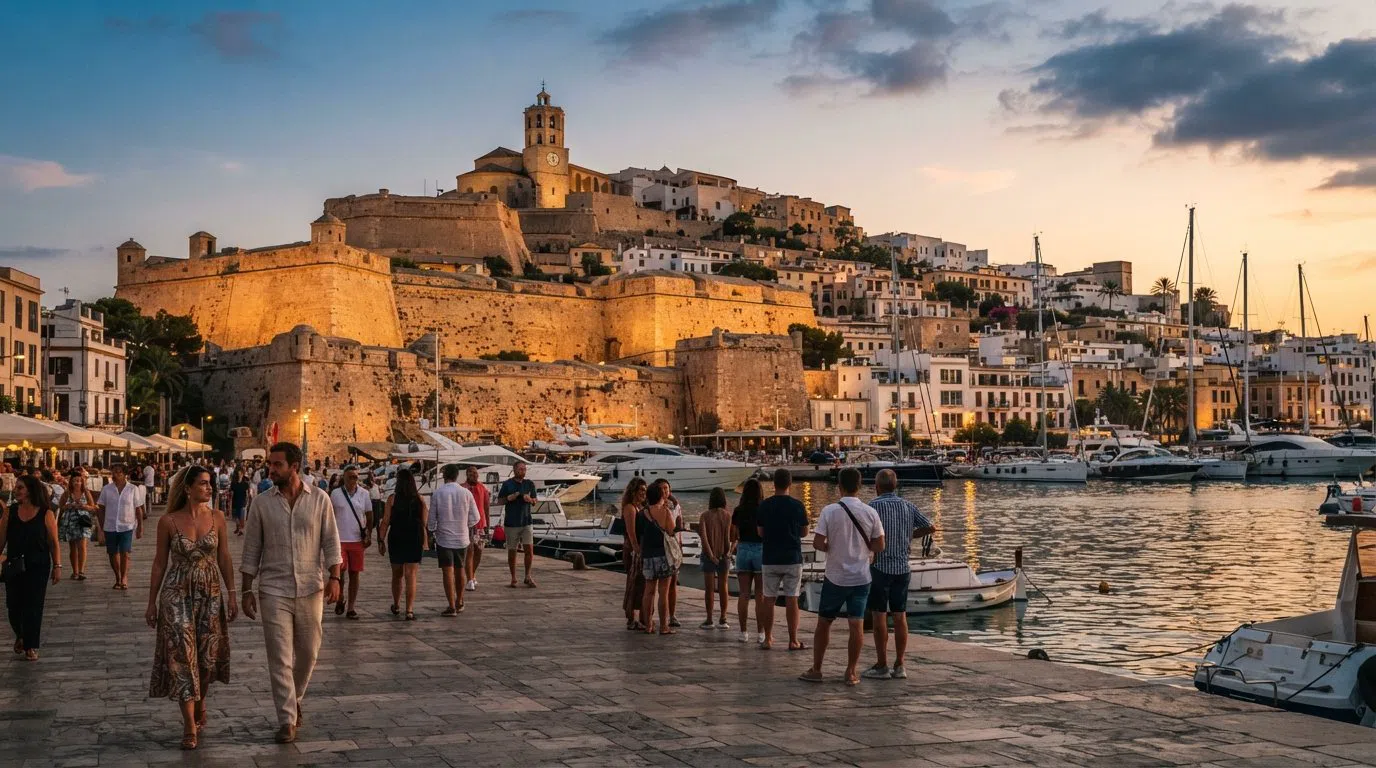
Climb through the Portal de ses Taules and the island changes pitch: the marina noise drops away, the cobbles start tugging at your calves, and Dalt Vila begins to unroll above you like a history lesson that never quite learned to sit still. Cats sleep on warm stone, the ramparts catch the light, and the cathedral keeps its watch over a port where superyachts still dock and Pacha still runs late. This is Ibiza’s oldest, most concentrated drama — a two-thousand-year-old core with Phoenician, Punic, Roman, Moorish and Catalan-Gothic layers all visible in the same stretch of wall, and a modern town around it that can go from serious sightseeing to a rooftop drink without asking you to change districts.
What Dalt Vila & Ibiza Town is known for
Dalt Vila is the bit of Ibiza that refuses to behave like a resort. It is steep, pedestrianised, and gloriously inconvenient in the best old-town way. The Renaissance walls were commissioned in the 16th century by Philip II to defend the island from Ottoman and pirate raids, and they still do what good fortifications should do: make you feel small, then reward the climb. The whole ensemble earned UNESCO World Heritage status in 1999 alongside the necropolis of Puig des Molins, which is exactly the sort of pairing that tells you this place has never been one thing for long.
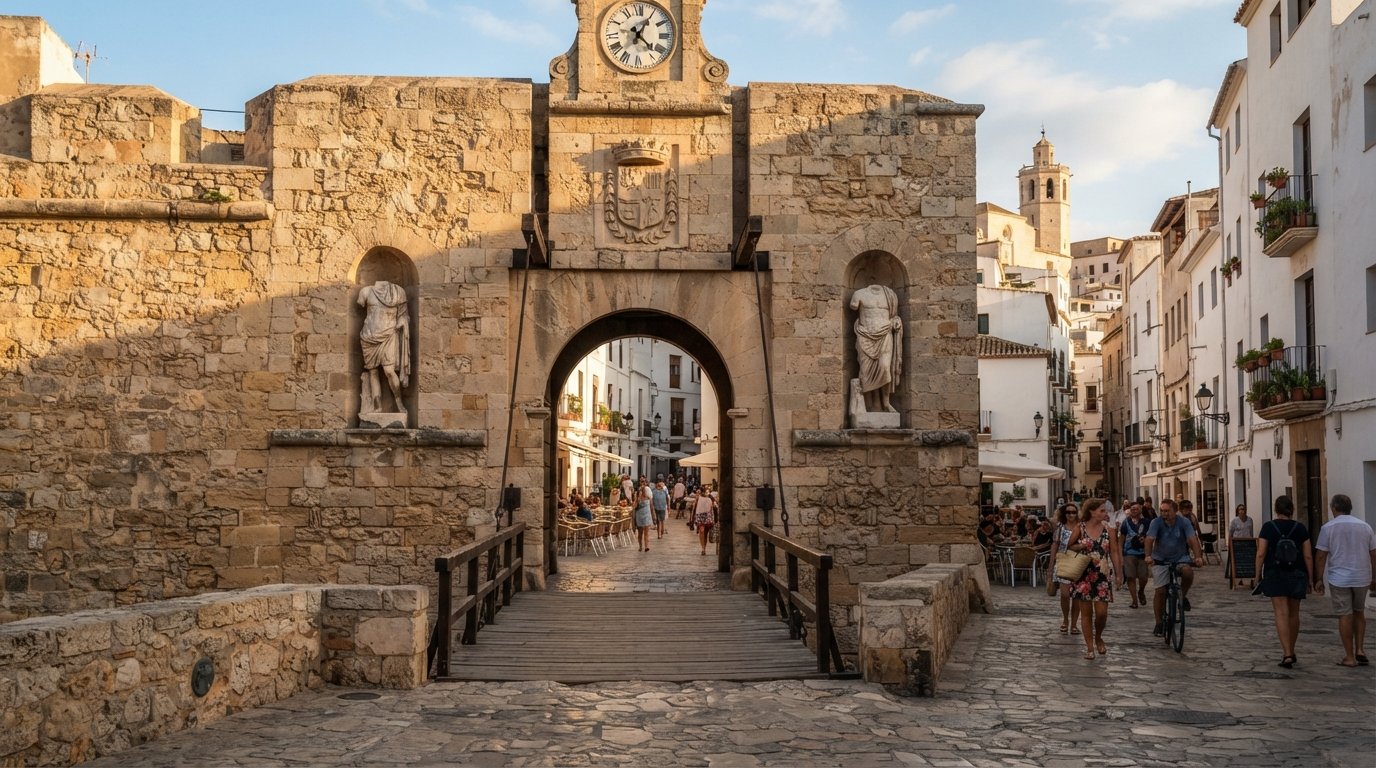
The proper entrance is the Portal de ses Taules, a ramped drawbridge gateway flanked by two headless Roman statues, and that detail alone tells you the tone here: solemn, theatrical, slightly battered, still standing. Step through into Plaça de Vila and the town starts stacking itself upward. The streets narrow, the stone warms, and the cathedral terrace waits at the top with the kind of view that makes everyone go quiet for a second. From the Catedral de Santa María, the port opens below, the marina spreads out, and on a clear day Formentera sits out there like a promise.
If you want the island’s best free viewpoint, this is it, and the island knows it. Just below the cathedral, the small castle and the Baluard de Santa Llúcia bastion are the classic sunset-photo spots, where the ramparts turn amber and the old town starts to look almost stage-lit. Ibiza can be all gloss and bassline if you let it. Dalt Vila is the reminder that there was a city here long before the guest lists.
Below the walls, Ibiza Town — Eivissa to locals — is the working counterweight. Sa Penya, the old fishermen’s quarter, is a tangle of bars and boutiques with a long memory and a late-night pulse. Passeig de Vara de Rey gives you the promenade version of the town, café terraces and a bit of parade-ground elegance. Across the water, Marina Botafoch is the yacht-and-designer showground, all broad shoulders and polished surfaces. The crowd shifts by the hour: cruise day-trippers and history buffs on the ramparts, a smart LGBTQ+ and fashion set in Sa Penya after dark, monied marina people at the port. It is the rare part of Ibiza where culture, glamour and clubbing sit within a fifteen-minute walk of each other, and where a serious day of sightseeing never needs a beach club as its punchline.
Plan your Ibiza trip
Live prices from our booking partners.
Guests & rooms
Free cancellation on many rooms. We may earn a commission when you book.
Where to eat & drink
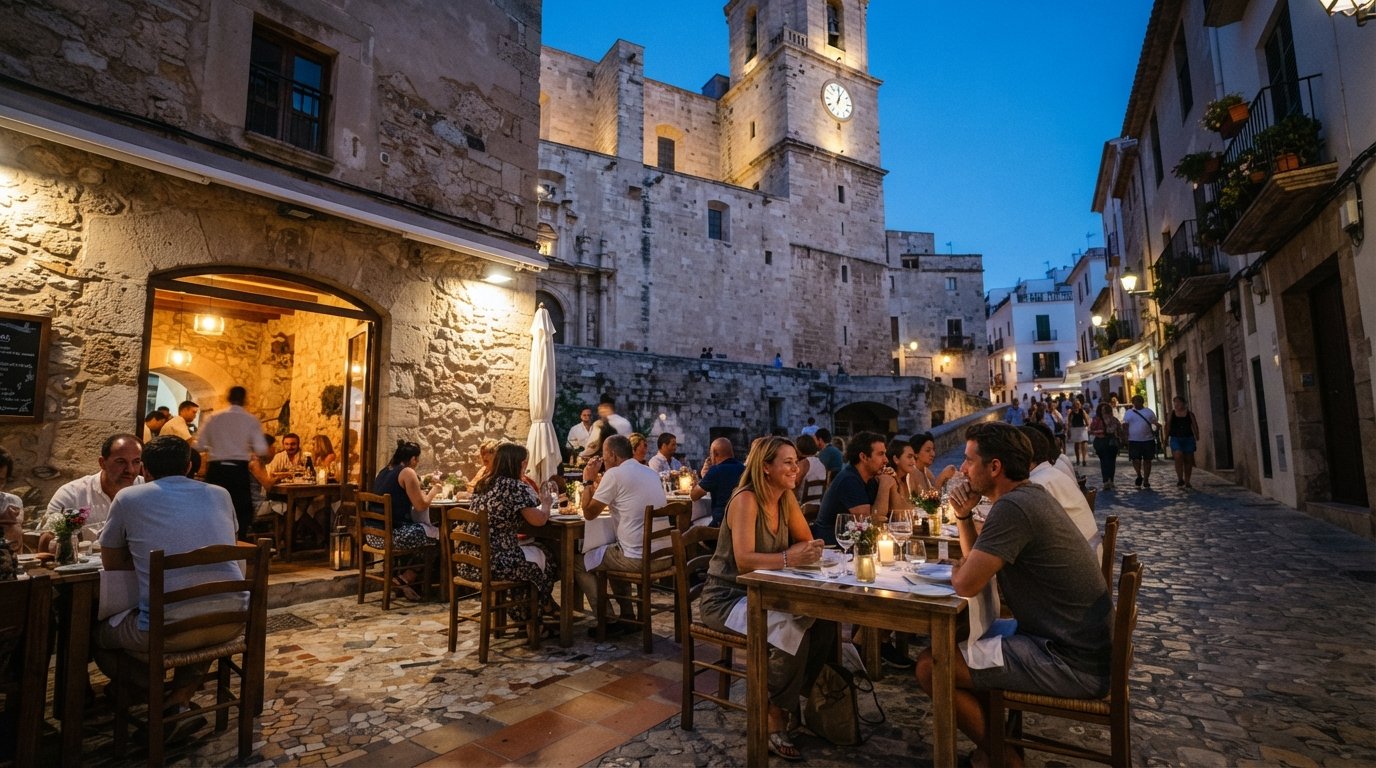
The best meals here happen where the old streets get narrow enough to make you slow down. Carrer de la Santa Creu is the kind of cobbled lane that rewards wandering, and it holds two of the neighbourhood’s most dependable tables. La Oliva, at No. 2, has been here since 1985, a French-Mediterranean institution with tiled floors, beamed ceilings and a terrace under the cathedral. Order with a sense of occasion: lamb rack in rosemary, lobster risotto, and the pleasant feeling that you’re eating in a room that has seen every phase of Ibiza and remained politely itself.
A few doors up, La Dispensa spreads itself across several old Ibizan houses and never feels like a single room, which is half the charm. One moment you’re in the Tuscan-styled La Madre, the next in a stone-cave space or peering towards the sushi workshop. It is theatrical without being silly, which is harder than it sounds in a town that can lean hard on atmosphere.
Up in Plaça de Vila, La Torreta keeps things market-fresh with sea-bass ceviche and beef tenderloin, while El Olivo Mio does modern Mediterranean plates in the same cathedral-adjacent orbit. This is where lunch can stretch without turning into a performance, and where the cobbles outside matter as much as the plate.
For something looser, La Bodega on Carrer de Bisbe Torres Mayans is one of those converted-stable places that understands the value of not trying too hard. It sits at the foot of the walls with patatas bravas, tortilla and chorizo, and a terrace facing the castle. That view does a lot of the work, but the room earns its keep.
Then there’s S’Escalinata, which spills down a stone staircase by the Es Portal Nou gate with cushions on the steps and tapas to share. It is the sort of place where one Mezcal Mule can become two because the setting keeps convincing you to stay. Spritzeria — Ibiza Old Town takes the opposite tack, turning the corner into a colourful little Italian bistro pouring fifteen versions of the Aperol spritz. In a town where many drinks are priced as if they come with a private mooring, that kind of cheerful specificity matters.
Down on Passeig de Vara de Rey, Café Montesol has been part of Eivissa since 1933 and still does what a landmark café should: all-day terrace, rooftop, and a steady view of the town going by. It’s the place to watch Ibiza Town behave like a town, not a brochure.
Going out
This is the district where the superclub is a short walk rather than a taxi ride, which is an underrated luxury until about 4am. Pacha Ibiza, by the port since 1973, is the grande dame — the island’s founding superclub, with a roughly 3,000-capacity room and headline residencies most nights of the season. Solomun’s Sunday nights, Marco Carola’s Music On on Fridays, the whole machinery of late Ibiza: it all lives here. The club opens around midnight and runs to about 7am, with entry typically in the €30–65 range depending on the night. You can feel the history in the queue, which is not something you say about every club.
Across the water on Marina Botafoch, Lío Ibiza takes the dinner-and-show model and dresses it in a more immaculate suit. It pairs fine-dining dinner and live cabaret with a late club, and the view back to the floodlit walls is the sort of thing that makes people forgive a strict dress code. No beachwear, no flip-flops; the door is not interested in your holiday logic. Next door, Chinois Ibiza, opened in 2022 from the Park Chinois London team, leans into the Asian-fusion supper-club niche with a rooftop and seasonal DJ residencies. It is glossy, yes, but it knows the skyline it is borrowing from.
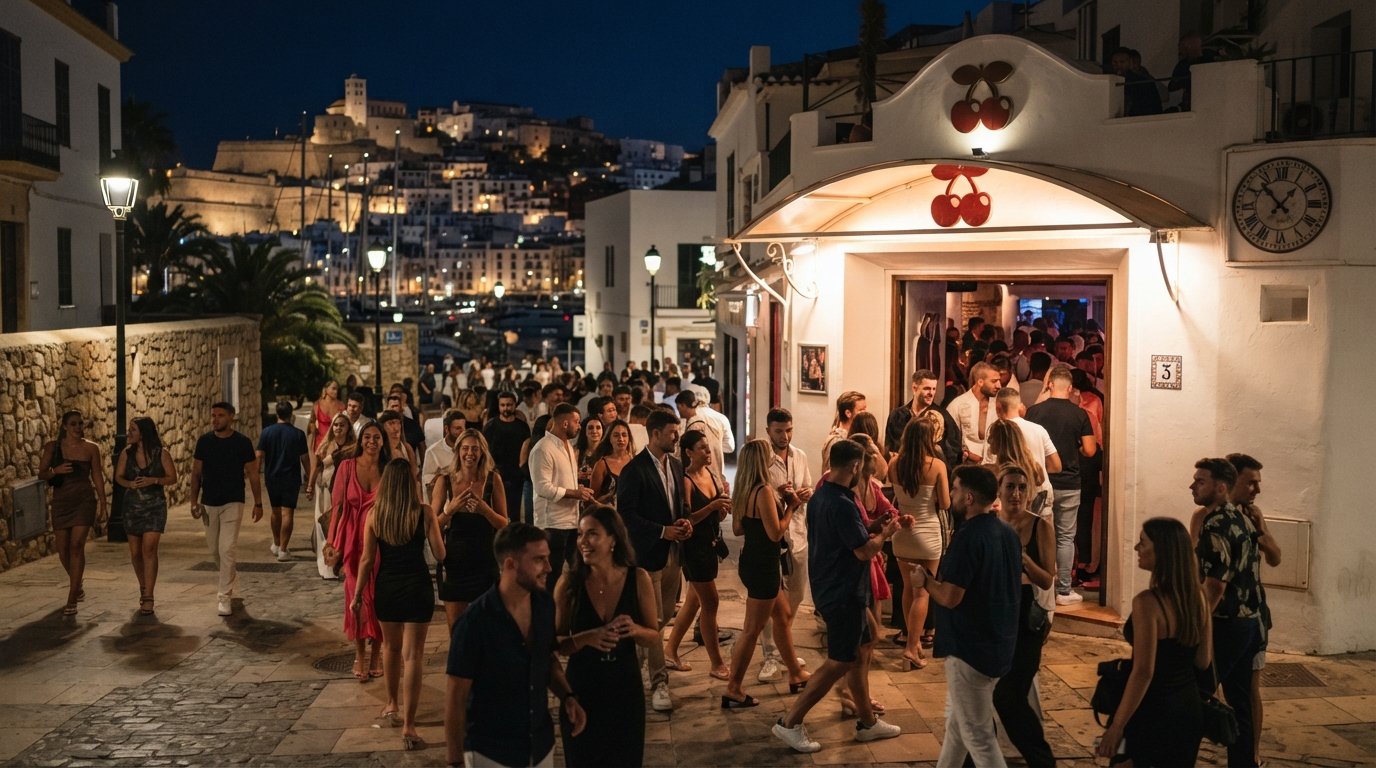
If you want to start smaller, Sa Penya is still the place where the night builds on foot. The old fishermen’s quarter has long been the heart of Ibiza’s LGBTQ+ nightlife, and its bars make a deliberate virtue of not rushing the evening. Drift, stop, talk, move on. Then decide whether you want the club, the cabaret, or just the walk home under the walls.
Things to do and what to see
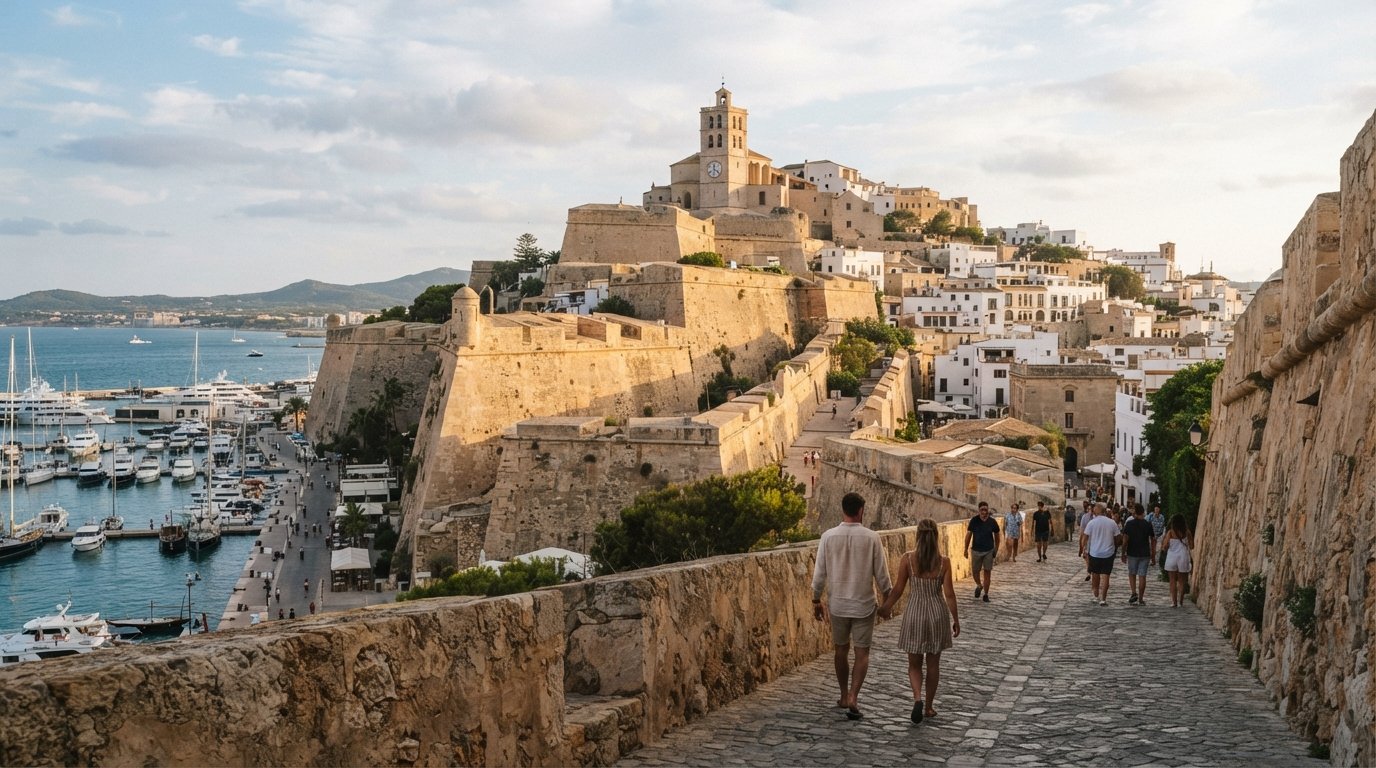
Give the ramparts a proper hour or two. The classic self-guided route starts at the Portal de ses Taules and climbs through Plaça de Vila to the Catedral de Santa María — free to walk, best done late afternoon when the heat drops and the stone starts to glow. The route is not difficult to understand, only to resist. Every turn gives you another angle on the port, another slice of sea, another reminder that this hill was built to be seen from below as much as climbed from within.
Along the way, the MACE (Museu d’Art Contemporani d’Eivissa) sits inside a former arsenal on Ronda Narcís Puget and keeps the neighbourhood from becoming a pure heritage set piece. It shows local and international contemporary work, closes Mondays, and shifts its midday hours with the season, so check before you go. That mix — fortress, museum, cathedral, port — is what gives Dalt Vila its odd, satisfying balance.
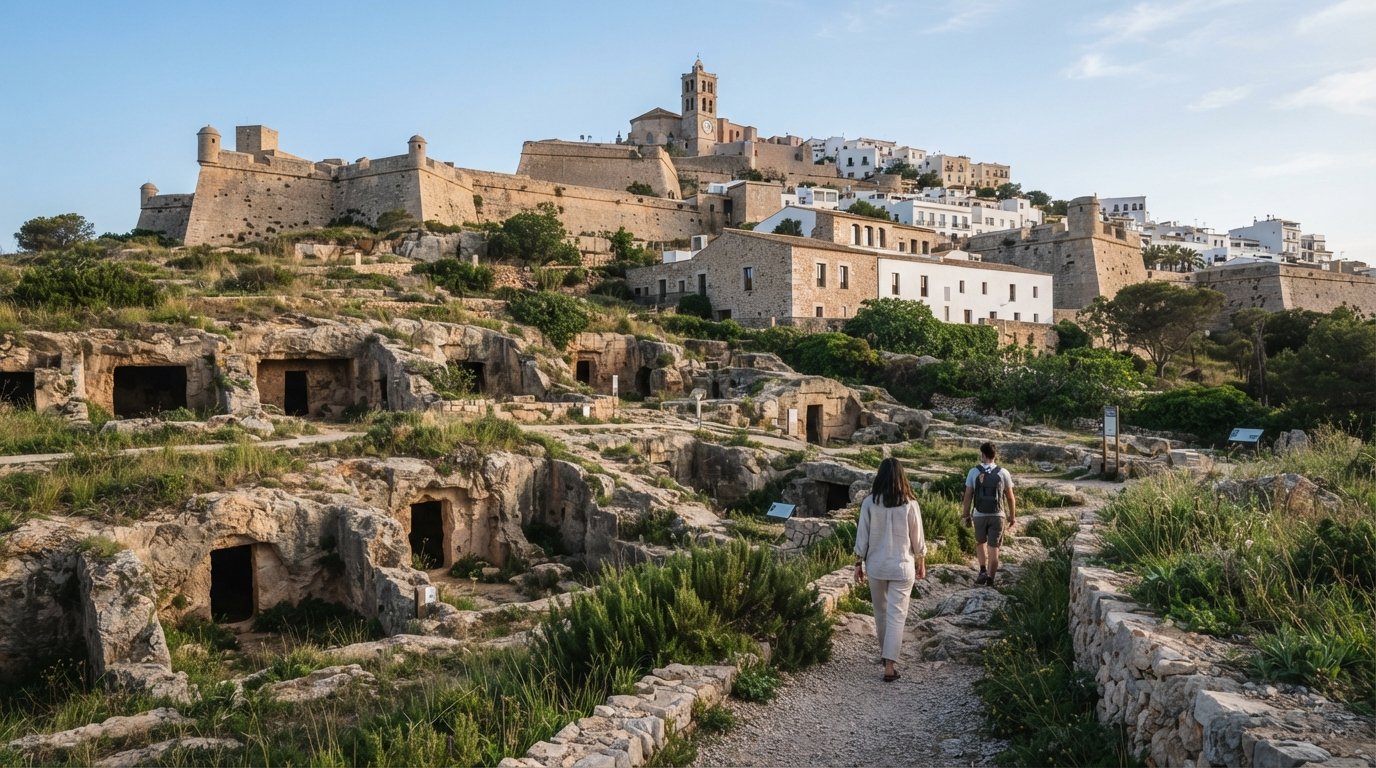
Below the walls to the south, the Necropolis & Museum of Puig des Molins is one of the largest and best-preserved Phoenician–Punic burial grounds in the world, with more than 3,000 tombs and a small monographic museum of grave goods. Admission is nominal, a couple of euros, and it keeps morning hours. It is one of those sites that quietly changes the temperature of a trip: suddenly the old town is not just old, it is layered with burial, trade and belief.
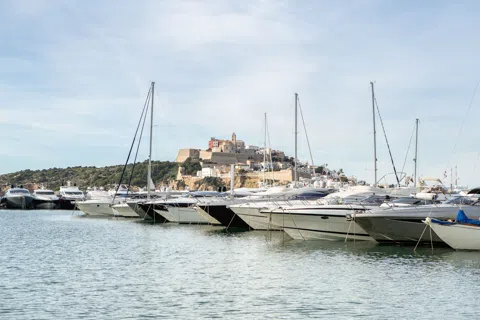
Back at sea level, wander Sa Penya and the streets behind the port for boutiques and the artisan Mercat Vell, the old market, then cross to Marina Botafoch for the view back at the whole floodlit fortress. The port-side perspective matters. Dalt Vila is beautiful from within, but it is almost more impressive when it glows above the water like a citadel that never stopped earning its keep.
If you’d rather have the story told to you, a guided old-town walking tour from the port is worth it. It runs roughly €15–25, which is a modest price for someone else doing the interpretive heavy lifting while you concentrate on the walls and the odd cat in the shade.
Don’t miss in Dalt Vila & Ibiza Town
Walking the ramparts of the Baluard de Santa Llúcia for panoramic views over the harbor.
Exploring the narrow, winding streets of the old fisherman's quarter, Sa Penya.
Browsing the independent boutiques along Carrer de Sa Carrossa.
Shopping
Shopping here splits cleanly by mood. Sa Penya and the lanes just off the port are the fun, browsable end: independent boutiques, jewellery, loose Adlib white-linen Ibizan fashion, leather and beachwear, all threaded between bars so you can shop and drink your way through an evening. That is very Ibiza Town — commerce with a soundtrack, and usually a terrace nearby.
The daytime Mercat Vell near the port is the place for local produce, cheeses and artisan souvenirs on the way up to Dalt Vila. It is not trying to be glamorous, which makes it more useful. You can pick up something edible, something handmade, and still have time to climb before the light goes.
For the other extreme, cross to Marina Botafoch, where the tree-lined promenade is lined with full-blown designer flagships — Louis Vuitton, Gucci, Dior, Saint Laurent, Loewe and the rest — aimed squarely at the superyacht crowd. It is more window-shopping than bargain hunting, but the point is the setting: Dalt Vila floodlit across the water, the marina polished to a shine, and the whole town split neatly between old stone and new money.
Where to stay in Dalt Vila & Ibiza Town
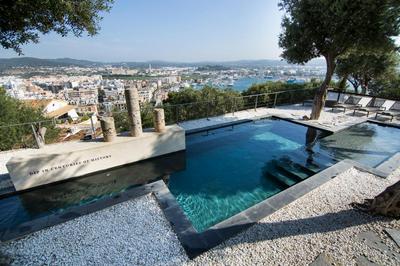
This is the walkable, do-it-all base, and the hotels understand the assignment. Inside the walls, small design hotels trade on history and views. Hotel Mirador de Dalt Vila, a restored 1904 mansion on Plaça de España with just a dozen rooms, is a Relais & Châteaux member, which tells you the level of polish before you even get to the staircase. La Torre del Canónigo occupies 14th-century buildings on the acropolis with rooms over the port and, in the right room, the sunrise. That phrase does a lot of work here.
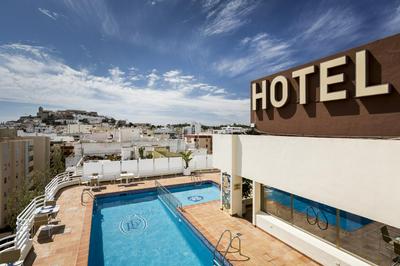
Down on Passeig de Vara de Rey, Montesol Experimental puts you at the very foot of Dalt Vila with a rooftop over the old town. It is the sort of address that lets you move between dinner, drinks and bed without ever feeling geographically ambitious. Larger and more contemporary hotels ring the port and Marina Botafoch, handier for late nights and boats, but noisier in peak season. If you want atmosphere, book inside the walls and accept the steps. If you want the easiest mix of central and lively, stay on the Vara de Rey/port strip. If you want glamour and space and do not mind taxiing to everything else, the marina is your zone.
Hotels in Dalt Vila & Ibiza Town
Our best-rated stays in this neighbourhood. Prices are approximate “from” rates — confirmed at the provider when you continue. We may earn a commission if you book through our partners — at no extra cost to you.
In this area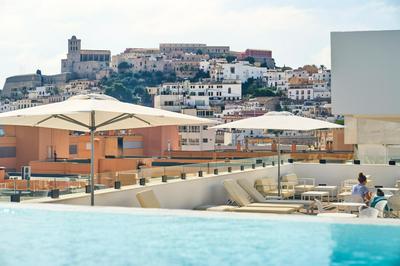 In this area
 In this area
 In this area
Dalt Vila & Ibiza Town
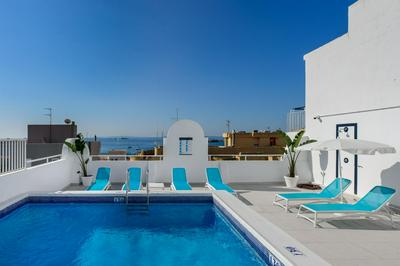
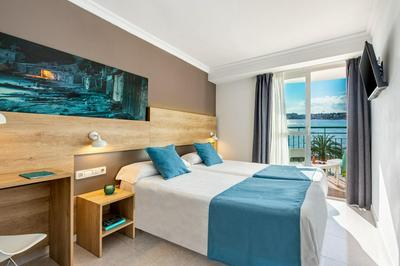
Hotel Vibra Vila -3SUP- New Opening 2026
7.6· 2,114 reviews
approx. from£76 / nightSee prices
 In this area
 In this area
 In this area
 In this area
 In this area
Dalt Vila & Ibiza Town
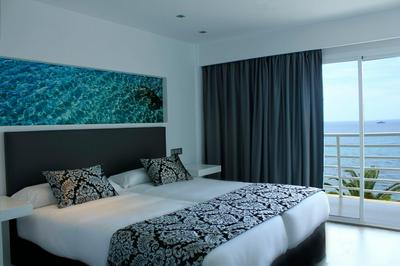
Mirador de Dalt Vila-Relais & Chateaux
9.3· 282 reviews
approx. from£335 / nightSee prices
 In this area
 In this area
Dalt Vila & Ibiza Town
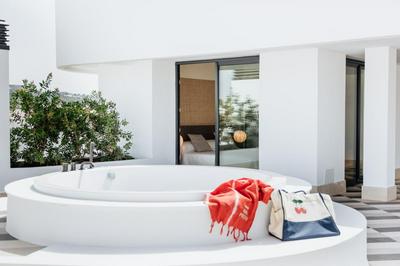
Hotel La Torre del Canonigo - Small Luxury Hotels
9.1· 839 reviews
approx. from£288 / nightSee prices
 In this area
Getting around
Ibiza Town is small and best done on foot, but Dalt Vila is genuinely steep and largely pedestrianised, so pack flat, grippy shoes and do not expect to wheel a suitcase to the door with any dignity intact. Cars can nudge partway in, yet the smarter move is to park at the base — free white-zone streets on the outskirts or a paid car park — and walk up through the gates. The hill is part of the experience, even when you are muttering about it.
From Ibiza Airport (IBZ) it is about a 15-minute taxi, roughly €20–25, or the frequent, cheap bus line 10 in around 20–30 minutes. The port, Sa Penya, Vara de Rey and Dalt Vila are all only a few minutes’ walk from each other, while Marina Botafoch is a short taxi or a longer stroll around the harbour. For the rest of the island you will want taxis — use the official Ibiza taxi app in summer, when ranks get busy — or a hire car, since Playa d’en Bossa is 10–15 minutes south and the beaches and villages are a drive away.
Gallery
Dalt Vila & Ibiza Town in pictures
Dalt Vila & Ibiza Town — your questions
Is Dalt Vila / Ibiza Town a good area to stay in Ibiza?
Yes — if you want culture and walkability rather than a beach-and-club strip. It is the island’s most central base: you can sightsee the UNESCO old town, eat well, and still reach Pacha and the marina clubs on foot, with taxis for the beaches and other resorts. The trade-offs are premium old-town and marina prices, steep cobbled streets inside the walls, and no beach on the doorstep.
Is Ibiza Town’s old town safe, and is it steep?
It is very safe: calm by day and lively but well-policed around the port and Sa Penya at night, though you should still watch your belongings in busy crowds. And yes, it is genuinely steep. Dalt Vila is a walled hilltop of cobbled ramps and stairs, largely car-free, so wear flat, grippy shoes and expect a climb up to the cathedral.
Can you visit Dalt Vila and the cathedral for free?
Yes. Walking through the gates and up the ramparts to the cathedral terrace — the best free view on the island — costs nothing. The cathedral nave is generally free too, the Puig des Molins necropolis museum charges only a couple of euros, and guided walking tours from the port run about €15–25 if you want the full history.
Is Dalt Vila better by day or at dusk?
By day you get the archaeology of it all; at dusk you get the mood. The ramparts go amber, the cathedral lights come up, and the whole hill starts looking like it has remembered how to be beautiful on purpose.